
TEA’s 27th AGM Highlights Ceylon Tea’s Resilience Amid Global Challenges
The Tea Exporters Association (TEA) convened its 27th Annual General Meeting (AGM), bringing together key industry stakeholders, government representatives and business leaders to discuss the challenges and future prospects facing Sri Lanka’s tea industry.
Held under the theme “Navigating Challenges,” the event highlighted the resilience of Ceylon Tea amid a year marked by geopolitical tensions, shipping disruptions, adverse weather conditions, declining production and growing concerns over quality.
During the AGM, Huzefa Akbarally was re-appointed as Chairman of the Tea Exporters Association for the 2026/2027 term. Addressing the gathering, he outlined the significant pressures currently affecting the industry, including disruptions to global shipping routes.
According to Akbarally, a substantial proportion of Ceylon Tea shipping routes has been affected by global conflicts and geopolitical instability, forcing many shipments to take longer routes around the Cape of Good Hope. This has resulted in significant increases in freight costs and created additional challenges for exporters.
Despite these difficulties, he emphasised the continued resilience of Sri Lanka’s tea export sector and expressed optimism about the industry’s ability to strengthen production and exports with the necessary support and stability in global markets.
Turning to the domestic production sector, Akbarally highlighted the importance of increasing the availability of green leaf supplies. He noted that Sri Lanka possesses the necessary expertise, export capacity and factory infrastructure to support higher levels of tea production.
He further stressed the potential economic benefits for smallholder tea growers, stating that improvements in productivity could significantly enhance household incomes. With appropriate government support and industry collaboration, he said Sri Lanka could potentially increase tea production to 350 million kilogrammes by 2030.
Among the measures proposed to improve productivity was block infilling, which was identified as a relatively low-cost strategy to increase yields among smallholders. Akbarally also renewed calls for policy support, including the restoration of the Tea Board’s brand promotion scheme, value-added export incentives and improved access to imported spices used in value-added tea products.
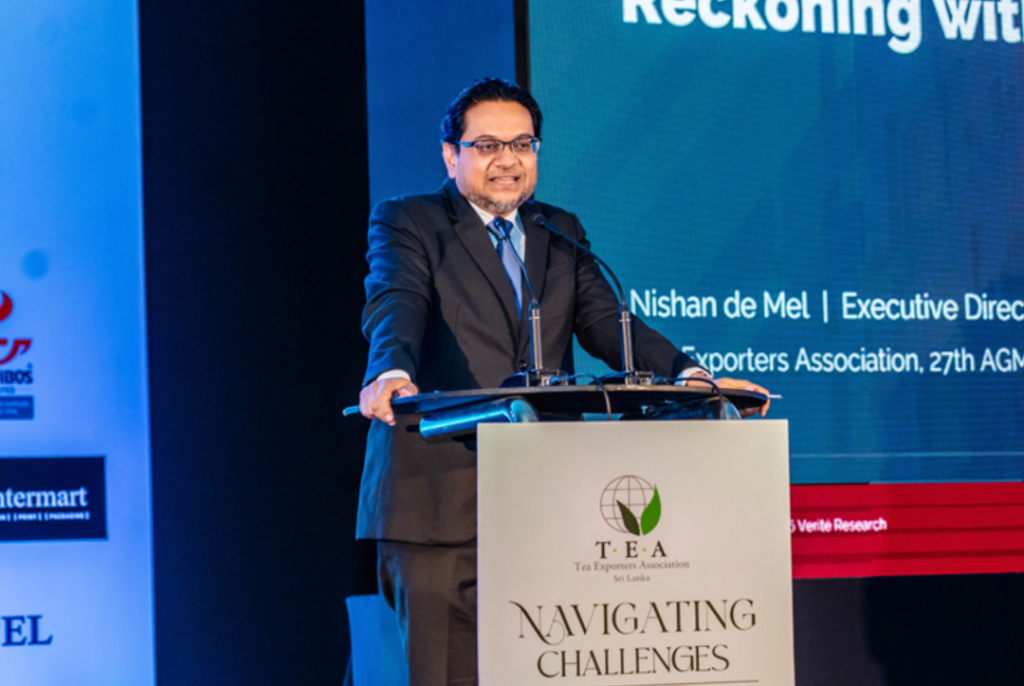
The AGM also featured a keynote address by Dr. Nishan De Mel, Founder and Executive Director of Verité Research, who discussed Sri Lanka’s economic position amid the global shocks of 2026.
Dr. De Mel noted that Sri Lanka had demonstrated a degree of resilience against external economic pressures, supported by developments in areas such as remittances and tourism. However, he also highlighted the importance of ensuring that economic recovery translates into meaningful improvements in the living standards of vulnerable communities.
Reflecting on Sri Lanka’s recovery from the 2022 economic crisis, he observed that while progress had been made in macroeconomic and fiscal indicators, significant socio-economic challenges remain, particularly in relation to poverty and employment.
Commenting on the additional wage increase for estate sector workers, Dr. De Mel described the measure as an important step towards addressing inequality and supporting workers in one of the country’s most economically vulnerable communities.
He also encouraged industries to engage in transparent and evidence-based policy advocacy, emphasising the importance of developing proposals that can be clearly understood and supported by the wider public.
As the apex body representing Sri Lanka’s tea exporting community, the Tea Exporters Association continues to advocate for policies aimed at strengthening the global competitiveness of Ceylon Tea.
Despite the challenges posed by geopolitical uncertainty, rising logistics costs, natural disasters and production constraints, the industry remains focused on strengthening smallholder productivity, maintaining quality standards, expanding value-added exports and diversifying international markets.
With continued collaboration between the government and industry stakeholders, Ceylon Tea remains well positioned to navigate current challenges and capitalise on future opportunities in the global marketplace.
The event also featured the 7th Outstanding Tea Producers Award Ceremony, recognising leading estates and factories across several tea-growing regions, including Ruhuna, Sabaragamuwa, Kandy, Dimbula, Uva and Nuwara Eliya, as well as the Low Grown CTC category.